Method and Deliverables
The method: structured support, adapted to your need
Every engagement starts with a close reading of your context, your challenges and your priorities. Depending on your situation, it can take the form of an audit, a roadmap, a launch sprint or ongoing marketing steering.
Before any engagement, we talk for 30 minutes, with no commitment, to take stock of your situation and identify the level of support that fits best.
The method is the same whatever the format. What changes is the depth of the work, and the point where the engagement stops: which service includes which deliverables.
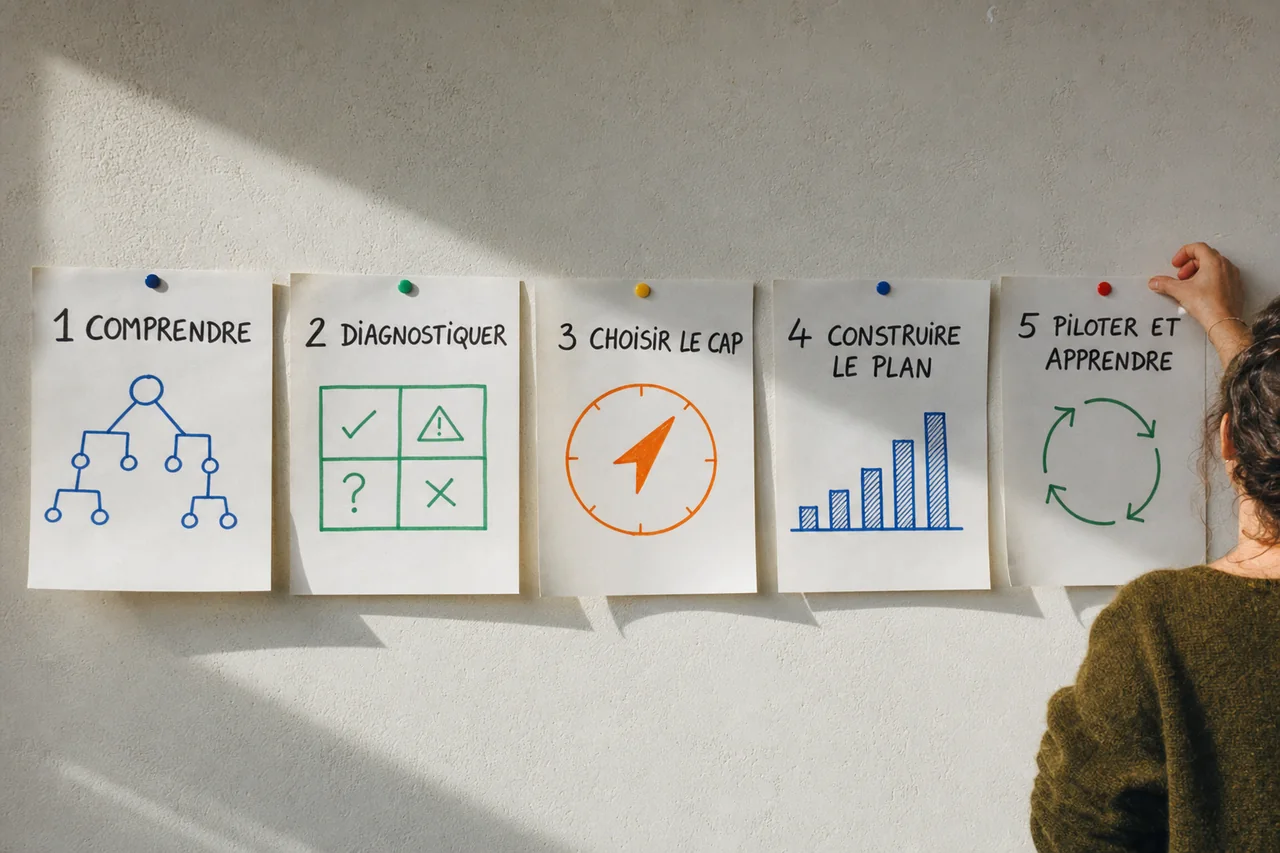
The five steps of an engagement
Understand
We clarify your context: your ambition, your model, your offer, your constraints and the decisions ahead. We also identify the people you address, patients, customers or consumers, their needs, their expectations and what holds them back.
Diagnose
I analyse what drives your performance: market, competition, current positioning, offer portfolio, messaging, customer journey, digital presence and available results. The aim is to separate the strengths to protect, the gaps to close and the opportunities to take.
Set the direction
We make the choices that give marketing a direction: priority audience, the need to answer, value proposition, positioning against the alternatives and the objectives to reach. The point is not to please everyone, but to become the most relevant choice for the people you can serve best.
Build the plan
I turn the strategy into a roadmap: objectives, priority initiatives, messages, channels, calendar, budget, responsibilities and tracking indicators. Every action has a clear function: supporting the positioning, meeting the audience's expectations and contributing to a measurable result.
Steer and learn
If the engagement runs over time, I coordinate delivery, track performance and organise the trade-offs needed. We learn from what works, from what has to change and from what the market says, to keep the plan alive and the spending useful.
This fifth step is what separates a closed engagement from ongoing support: steering over time.
What each step produces
A method is only worth the decisions and the tools it leaves with the business.
| Step | What exists at the end |
|---|---|
| Understand | A shared reading of the situation and a clear engagement scope. |
| Diagnose | A documented picture: strengths to protect, gaps to close and opportunities to take. |
| Set the direction | A priority audience, a need to address, a positioning and decisions that are owned. |
| Build the plan | A roadmap that is dated, costed, assigned and measurable. |
| Steer | A review rhythm, traceable trade-offs and a plan adjusted to results. |
Scroll to see the results column.
The decisive point is the third: setting the direction. The diagnosis reveals the opportunities; the strategy organises them around a clear direction, a priority audience and a strong value proposition. Teams, budgets and messages then move the same way.
How do you recognise a useful plan ?
A useful marketing plan turns an ambition into a direction, then that direction into coordinated, measurable actions.
It contains:
- A clear business objective: landing a launch, winning market share, growing a segment, increasing customer value or opening a distribution channel.
- A priority audience: the segment the business chooses to focus its resources on, because that is where it is best placed to create value.
- A value proposition and a positioning: what the offer brings, to whom, and why the brand is credible in offering it.
- Priorities and a calendar: the initiatives that matter, organised over time.
- A budget and responsibilities: settled investments and a clear role for everyone involved.
- A few steering indicators: simple enough to be tracked regularly, useful enough to guide decisions.
Deliverables
Depending on the format of support, you receive all or part of the following, in formats designed to be picked up directly by your teams and partners.
| Area | Possible deliverables |
|---|---|
| Diagnosis | Marketing audit, competitive analysis, ranked recommendations, impact / effort matrix. |
| Customer and market | Segmentation, personas, needs analysis and customer journey. |
| Brand and offer | Positioning, value proposition, key messages, offer architecture or brand territory. |
| Plan and activation | Annual marketing plan, launch plan, campaign roadmap, landing page and content recommendations. |
| Steering | Budget, calendar, indicators, dashboard and tracking tools. |
Scroll to see the deliverables column.
The exact deliverables are set at the start of the engagement, according to your challenges and the format chosen. See which deliverables are included in each level of support.
How we work together
The engagement moves forward through prepared working sessions, with clear decisions and a written record of the main trade-offs.
Your teams, agencies and partners are brought in at the right moment, so that everyone can act from the same direction, shared priorities and clear briefs.
What you keep
At the end of the engagement, you have a clarified positioning, a dated and costed plan, key messages and tracking tools designed to be used by your teams.
My role is to structure, decide with you and steer when needed, not to replace your teams nor to promise results before analysing your situation.
Book a 30-minute call
Thirty minutes to lay out your context, your priorities and the level of support that fits. It's the first step of the method, and it costs nothing.
Or write directly to contactlauregenin.com